for Removing STEM Subject Segregation and Gender Bias By STEM Research Center
Wednesday March 5th, 2025
Registrasi klik disini:
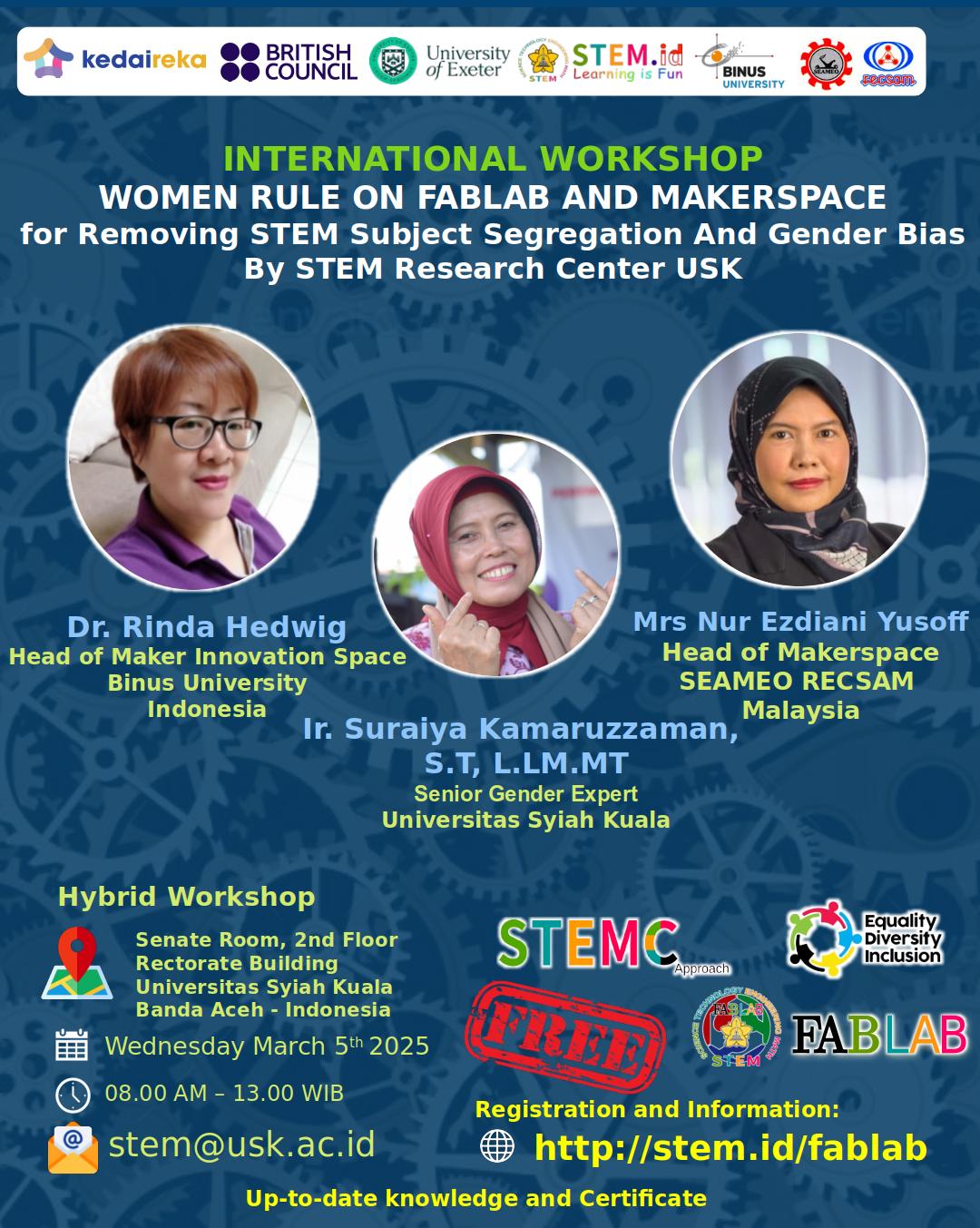

Time: Mar 5, 2025 09:00 Jakarta Join Zoom Meeting https://zoom.us/j/91281756474?pwd=Vgv05whm7Hhk4qHHVjQQYZw8Px8Xf6.1 Meeting ID: 912 8175 6474 Passcode: 172506
Past Events
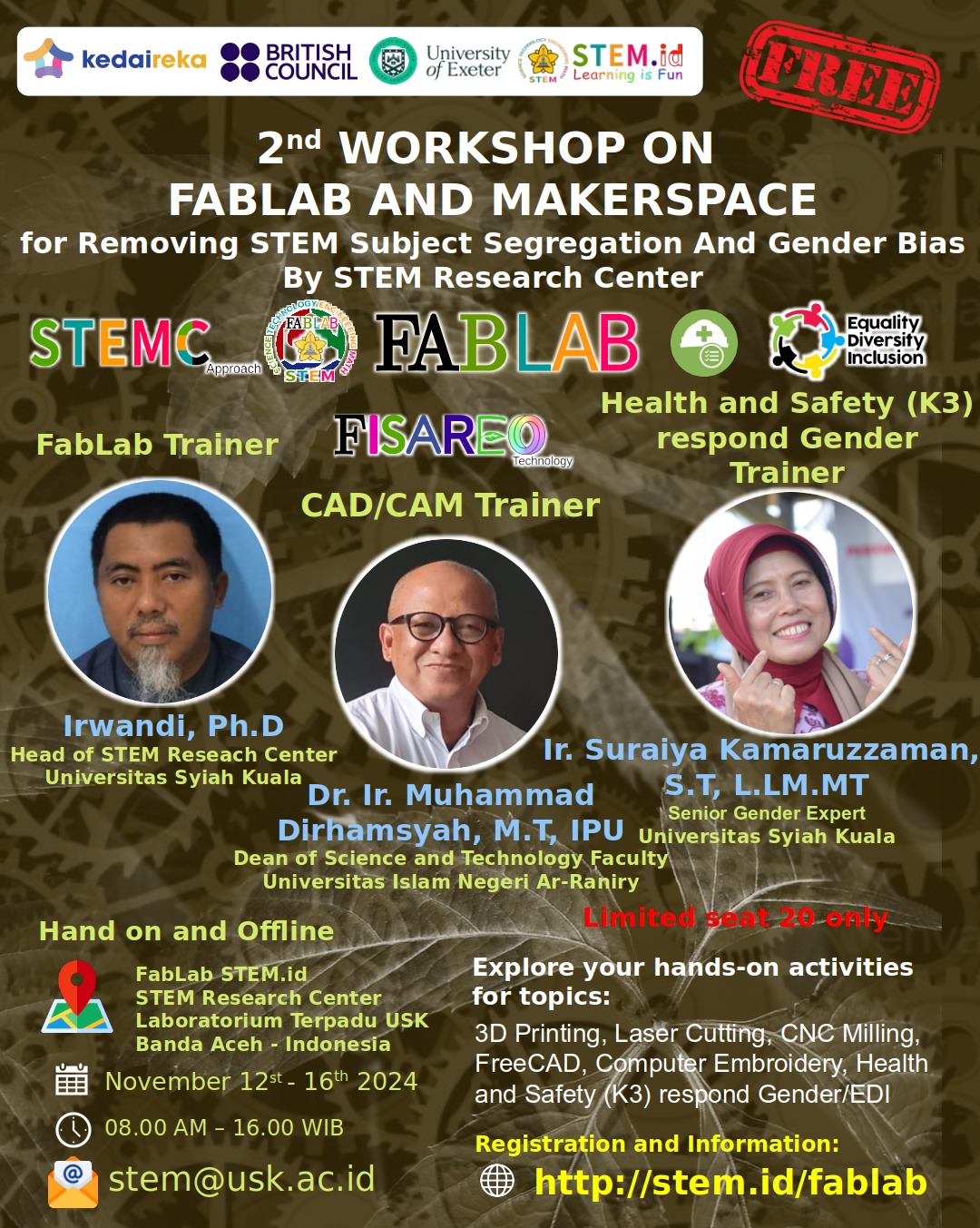
2nd WORKSHOP ON FABLAB AND MAKERSPACE
for Removing STEM Subject Segregation and Gender Bias By STEM Research Center
November 12st - 16th, 2024
FabLabs.io
FabLab STEM.id
It started with our experience of attending the FabLab and Makerspaces for Science workshop on 5-7 October 2015 and the PHYSWARE 2015 - Preparing 21st Century Physics Teachers Workshop on 25-30 January 2015. Both workshops were when Irwandi pursued his doctoral education at ICTP (International Center for Theoretical Physics) in Trieste, Italy. The two workshops were so inspiring that the STEM (Science, Technology, Engineering, and Mathematics) Research Center was formed at Syiah Kuala University. After receiving funding from PEER-USAID, the STEM Research Center was established on December 14, 2017, with the
Rector Decree Number 2239/UN11/KPT/2017. The STEM Research Center has started activities to advocate for the development of integrated learning in Science, Technology, Engineering, and Mathematics (STEM) so that the learning process in the classroom becomes interesting and enjoyable.
In connection with FabLab and Makerspace activities in 2018, the head researcher revisited the ICTP Scientific FabLab to establish collaboration. Then, in 2019, a team from the STEM Research Center visited the Makerspace at Rutgers University in partnership with PEER-USAID partner Eugenia Etkina. This visit showed how beneficial it would be if students or the general public were given access to the FabLab or Makerspace. In 2020, the STEM Research Center held the 1st SEA STEM conference with one of the key speakers from Exeter University. In 2023, we will discuss collaboration with the University of Exeter UK in EDI (Equality, Diversity, and Inclusion). Based on our experience of seeing firsthand the activities of FabLab and Makerspace, there is an urgency to provide opportunities for women, so we prepared a proposal with the title "Removing the subject of segregation and gender bias in STEM by enabling makerspace and FabLab access in universities" which received funding support from the British Council for implementation in 2024.
Funding from the British Council has limitations, and several activities must be removed from the proposal for budget adjustments; for example, they cannot be used for domestic travel activities. In February 2024, it turned out that the British Council was working with the management of the Kedaireka Matching Fund to propose a matching fund for 2024. With this matching funding support, we are preparing a proposal to assist with additional activities not covered by funding from the British Council. The topics proposed to the British Council are related to EDI, STEM, and FabLab, with the output of eliminating or reducing segregation and gender bias in STEM subjects. With this opportunity, what is proposed to the Kedaireka Matching Fund will add aspects of how creative products produced from FabLab or Makerspace activities can be commercialized.
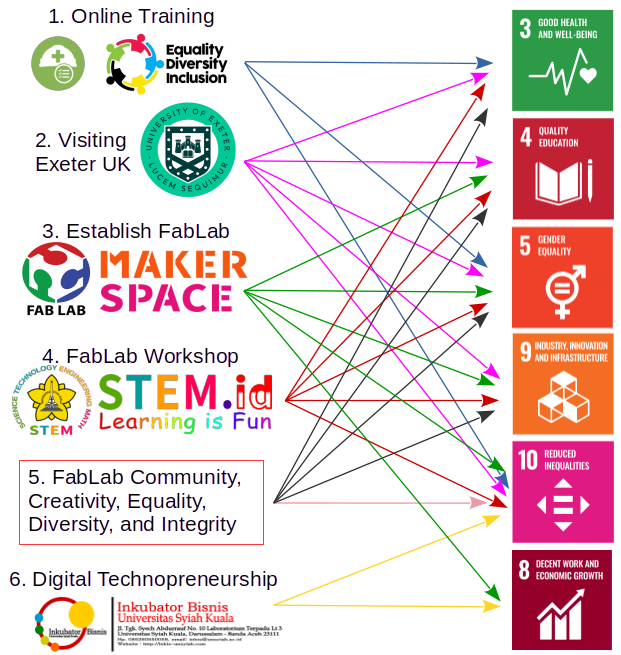
The FabLab project support by British Council and Kedaireka Goal:
Location
FabLab STEM.id, STEM Center, Laboratorium Terpadu Lantai 3. Jl. Syech Abdurrauf No 10, Universitas Syiah Kuala, Banda Aceh, Indonesia 23111
stem@usk.ac.id
FabLabs.io
FabLabs.io
Establishing Aceh FabLab Community
For the sustainability of this project, we established the Aceh FabLab Community which will continue the activities and commercialize them as a form of job creation opportunity.